
I Will Go Low
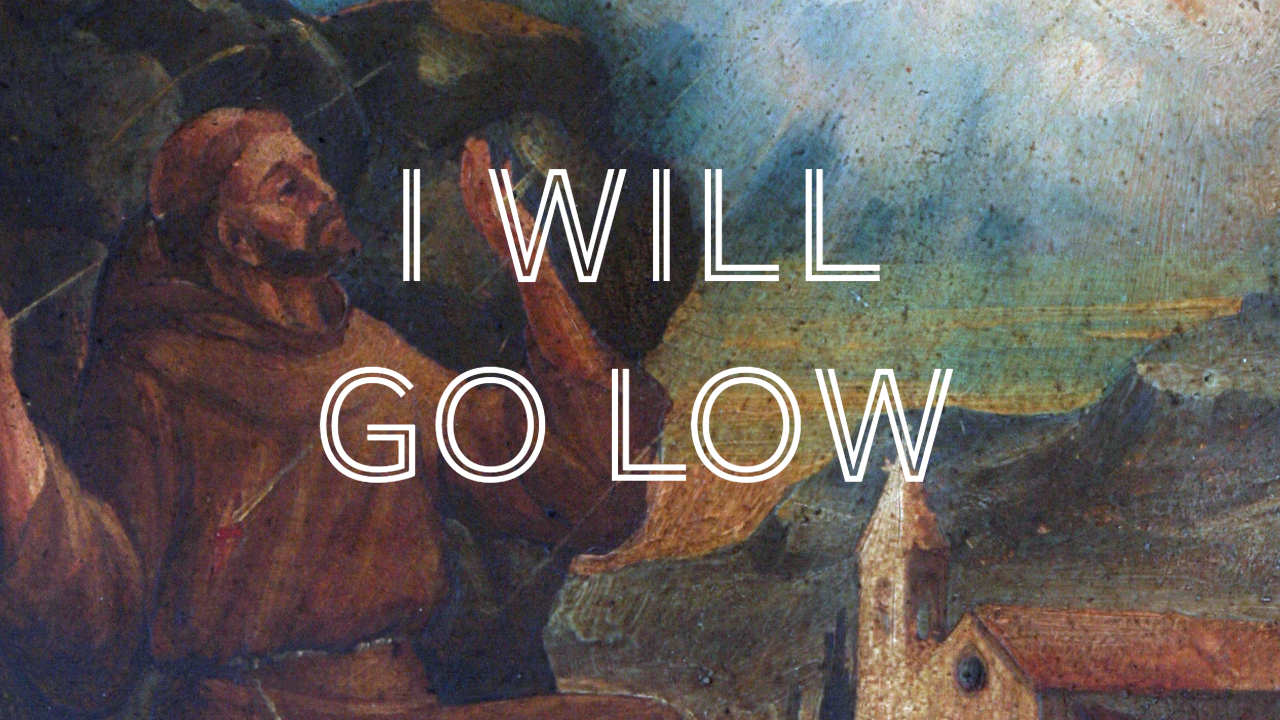
I will go low and become a servant and trust God to raise me up.
When I moved to Greater Boston in 2008, I asked God what he wanted me to do, and he said, "Go low."
Honestly, I didn't know what that meant. Or even, what God was talking about. I made a decision then that I would volunteer for the worst jobs, take the lowest seat in the room, and try not to exalt myself. Let me tell you, it was an eye-opening experience.
And any time I tried to exalt myself, I got a good wallop.
I learned a lot about pride in those years
in Boston.
I learned that you can't reason with a proud person.
I learned that pride blinds you
from seeing what's right in front of your face.
Pride makes you blind.
And if you are a religious person,
you begin every conversation
thinking you and your beliefs are right
and you cannot change.
You become the revival police
and you become the heresy hunter.
And you are double blind.
You become blind to people, and blind to God.
Today we are going to talk about one of the spiritual laws of the universe.
God opposes the proud, but gives grace to the humble.
That is James 4:6.
Anyone who works in the arts
knows a spiritual law of the art world:
there are two kinds of artists,
those who produce
and those who promote.
Whenever you see a really talented person
rise to the top and be highly successful,
you find that there is a person in the background
who channels that ability
and does the pushing,
so that the artist can be free.
Promoting yourself is a full time job.
Robin Williams once said
that the only thing
worse than being all alone
is being in a room full of people
who make you feel all alone.
And whenever you get in a room full of promoters
and climbers
you feel this way.
They are sizing you up
and measuring you.
And they are looking for
ways to get ahead.
And no amount of effort on your part
is going to get them to see you.
One time I was involved
in a regional ministry event,
and there were a lot of national ministry leaders
who were there.
I had just returned from England,
and I was planning on going back long term.
I made a commitment to be there,
and I was there to honor my commitment.
And there were a lot of problems,
and it was costing me a lot of money.
And I was going low.
And it was hard.
And these national leaders
thought I was the janitor.
(As an aside, you can tell a lot about a person
by how they treat janitors,
secretaries,
and waiters.)
Then I unveiled a life-sized copy of the Ark of the Covenant.
One of them started to talk to me
after he found out I was one of the leaders
of the gathering.
And as we talked,
the man got visibly angry.
I was telling him
how I listen to God
and do what he tells me,
not do fundraising
only tell the story,
and how I don't own anything.
He was the owner of
the largest Christian fundraising
and development company in the country.
"How are you ever going to build anything
that way?" he said,
and he marched off.
This week
we have been in the book of Job
and I'm sorry we had a truncated version
of the story,
because Job is not about suffering.
If you concentrate on the arguments
of his friends
you will think this book
is all about why the righteous suffer.
And Job does suffer,
at the hands of his friends.
Their religious pride
is more painful
than the trauma in his life.
And in the middle of the book
Job cries out
"no amount of arguing is going to convince you
that I did nothing to cause this pain."
And then he says,
"but I know my redeemer lives
and at the last day in my flesh I shall see God."
If you concentrate on the conversations
between Job and God
you get a very different story.
God answers Job's questions by a two chapter
song about Leviathan.
Leviathan is the king of the sons of pride
and of every high thing.
The book ends
with Job humbling himself,
praying for his proud friends
and having everything returned
seven times.
Jesus was tested and confronted
every day
by the religious authorities
and he never convinced them.
In a veiled parable
he says to them
you would never believe
if even a man rose from the dead.
And in the face of that,
Jesus still
emptied himself,
took the form of a slave,
and suffered and died upon the cross.
And after
that
God exalted him
above every name in the Universe
and at the name of Jesus every knee shall bow.
This is central to the spiritual life.
The world says,
I have to step on people
to get ahead
and when I get ahead
then I can make a difference for God.
There are many people who do this,
and it doesn't matter.
If you are a taker and a user,
it always comes through.
The Kingdom of God says,
I am going to listen to God
and do what he tells me.
And some days
Jesus is going to take me
into situations
that are not ideal.
And all my hopes and dreams
have to die with him,
and I have to trust his process
that I will be lifted up
in this life
and even more so in the life to come.
There was an old saying in vaudeville,
be nice to the people on the way up,
because you will meet them again on the way down.
I wish I could say it was the secular artists
that were the ones who were hard to work with.
I have only had one bad experience with an artist
in the world.
Most of the artists I worked with in the professional world
were generous, curious, and kind.
I have dozens of bad experiences with Christians.
If you believe you are the one with the answer,
you might be the problem.
So how do we practically work this out?
First,
settle it in your mind
that what you do is a service to others.
It is not your practice
and it is not about you.
It is not about you.
You may be God's gift to the world,
but the world will know it if you think you are.
Your gift is an offering.
Jesus really was God's gift to the world
but he emptied himself.
Always choose to let God lift you up.
Second,
you have to trust the process.
One of the most important people
in the Bible
was Joseph.
He started out pretty proud.
He was puffed up.
And he ended up in a process
where he was taken pretty low.
He was put into prison,
and forced to sit there for years.
And in the end,
God raised him up
and made him second to Pharaoh.
You know there were folks
who had been angling to get to that position,
who played their cards right.
And they were passed over for this foreign prisoner.
Joseph probably had to contend with
the "deep state" so to speak--
the bureaucracy
of Egypt
and it wasn't easy.
Going low
is never easy.
But it will build you up
and you will develop character,
and character turns into hope.
And hope does not disappoint.
Third,
humility requires honesty.
Sometimes it takes more humility
to acknowledge your strengths.
There is nothing noble about
selling yourself short.
There is nothing spiritual about downplaying your gifts
and your abilities.
It is just as bad as puffing things up.
Don't add, or subtract.
Be truthful.
And part of being truthful
is honestly assessing what needs improvement
and what is a strength.
And going low
does not mean
you do second rate work,
or adopt a poverty mentality.
Poverty is not humility
and wealth is not pride.
Some of the proudest most entitled
people I have ever met were
chronically poor.
Graham Cooke once said that poverty is not a lack of resources
but rather
a lack of possibilities.
Holding, grasping,
and acting like you need to grab and hold on
is not humility.
Going low
does not mean you pass over opportunities.
Going low
doesn't mean you play to lose.
You still need to go in there with the attitude
I am going to give it my best.
It just means,
I am not going to push ahead to the front
and step on other people.
You still go in there with intention
of getting the part,
getting the commission,
getting the sale.
You get it by outshining others with your good work,
not by crushing those in front of you.
As I mentioned.
There are two kinds of people in the arts,
those who produce
and those who promote.
Eventually,
the promoters
run out of material.
They all steal from the producers.
And this is an important test for you.
This happens all the time,
and a few famous names and companies
have a record of doing this.
When another author started making a habit of copying my work,
I had two choices.
God told me not to sue him,
so I had to go low.
I paid attention,
but I had to still forgive,
and I had to still walk with quiet confidence.
It was very hard.
It got really hard
when people would say
I should go meet this person
because he sounds a lot like me.
He was good at promoting,
and in the US promotion
equals credibility.
Seth Godin gave me good advice.
You have good ideas.
Keep having good ideas.
People are going to steal them
and when they do,
you take it as a compliment.
I made a decision,
I would become a better writer.
I developed a writing style that is very hard to copy,
and even harder to copy and paste.
When you take away the thought lines,
it no longer makes sense.
That is going low.
You trust God is going to make it right.
And God will.
Of all the twelve I wills,
this is the one that sets our house apart.
Everyone else out there is
promoting
bigger
faster
harder.
When I worked in the Prayer movement
people used to talk about the Herrnhut Prayer meeting.
This was part of the Moravian revival,
and the prayer meeting lasted
for over 100 years.
Yes,
around the clock,
continually,
for 100 years.
That prayer meeting had a big impact:
the conversion of John Wesley
and the Methodist revival.
The ending of the global slave trade,
and the 19th century Protestant missions movement,
all have their roots in that prayer meeting.
Not bad.
I have heard a lot of sermons and rah-rah
about Herrnhut.
People think it was a big crowd all the time.
No.
There were usually on average three people in the room.
That is average.
So that means,
sometimes there was somebody there
all alone.
That lonely guy
was probably there at three in the morning.
Often one person would arrive
and another would leave.
We don't know their names.
Rees Howells
had a daily prayer meeting in Wales,
and every day
they would listen to God and ask how to pray,
and God would direct them.
It was in the middle of World War II.
The next day
they would read the answers to their prayers
in the Newspaper.
We don't know their names,
there were about four people there.
Some have said that little prayer meeting
probably had the biggest impact on the outcome of the war.
I hope you see that these twelve I wills
are not rules.
They are a lifestyle
and a culture.
My goal in this house
is not to make a name for myself,
or build my ministry or my personal brand.
The goal is to build a culture of discipleship
that continues after I am gone.
Making the Belonging House commitment
is about being a different kind of artist or creative person.
It is about changing the culture
of this planet.
I will go low,
and become a servant,
and trust that God will raise me up.
Listen to the Lord and do what He tells you
Our message is the ministry. So don't just listen to this teaching. Do it.
This week, choose the lowest seat once a day. Take the job no one wants, serve someone who can't do anything for you, or let another person go first. Before you start, ask the Lord, "How do you want me to serve today?" Do that for seven days, and trust Him to do the lifting.
Come under the roof
Belonging House is a movement of artists and creative people, now reaching thirty-eight nations, learning to listen to God together. We are not trying to survive the storm. We are the storm.
- The Friday email is the thread that holds us together. Sign up at belonging.house and you get the full archive, your very own private library.
- Make the Belonging House Commitment, the Twelve I Wills, and you're welcome to join our Mighty Network community.
- Pray with us daily at 7am ET / midday UK, and gather with the House of Artisans each week at 1:00 ET: Belonging House on Zoom.
- Real Mail: original artwork in your mailbox every month, crafted with Human Intelligence.
- We are a 501(c)(3) through the Missionary Church International. Give to Belonging House here.
Follow and pass it on
Follow Belonging House Fellowship wherever you listen so each week's teaching comes to you, and leave a rating or review if your app allows it. It's how another artist finds us. Then send this to one creative person who is tired of the climb. We aren't recruiting. We're raising up, one person at a time.
People like us do things like this.
Fear not God can be trusted
Subscribe to my newsletter to get the latest updates and news
Member discussion